
안녕하세요.
postnova 제품을 국내에 공급하는
해외 공식 한국 총판 노바솔루션입니다.
노바솔루션은 Postnova의 한국 대리점으로서
시료와 분석 목표를 바탕으로 AF2000 AT·MT 모델 선정, AF4/HF5 채널 구성,
MALS·DLS·RI·UV·ICP-MS 연계와 메서드 구축을 지원합니다.
Comparison of Sensitivity: Silica Nanoparticles studied by Zetasizer Nano S vs. ZSP Coupled Online with Centrifugal Field-Flow Fractionation |
ㅣIntroduction
Engineered nanoparticles are of widespread use and are nowadays found in various kinds of products in form of additives, thickeners or fillers to obtain products of defi ned properties for food and cosmetic industry and even for biomedical applications. Investigations regarding environmental issues are also addressed wherein low detection limits as well as high sensitivities are required. The characterization of the nanoparticles is therefore highly important to ensure constant quality as well as reliability. The coupling of Centrifugal FFF [1] with online Dynamic Light Scattering (DLS) by the so called “flow-mode” option is a straight forward technology to combine facile separation and real-time detection of nano- and/or microparticles. The “flow-mode” option is realized by connecting a special quartz flow cell into the detector flow stream delivering accurate size information during the analysis. Besides separation and detection this hyphenated setup allows the user to further enhance the sensitivity and to improve the detection limit bearing the advantage to analyze highly diluted samples. This system features the novel CF2000 coupled directly with a DLS detection device (Malvern Zetasizer Nano Series). The sensitivity levels achieved by either using a Zetasizer Nano S [2] or the novel Zetasizer Nano ZSP [3] are compared. Analysis of a silica (SiO2) sample mixture showed a 2-times higher sensitivity by choosing the latter device (Nano ZSP).
ㅣComparative Study: Online Sensitivity of Zetasizer Nano Series S and ZSP Coupled with CF2000
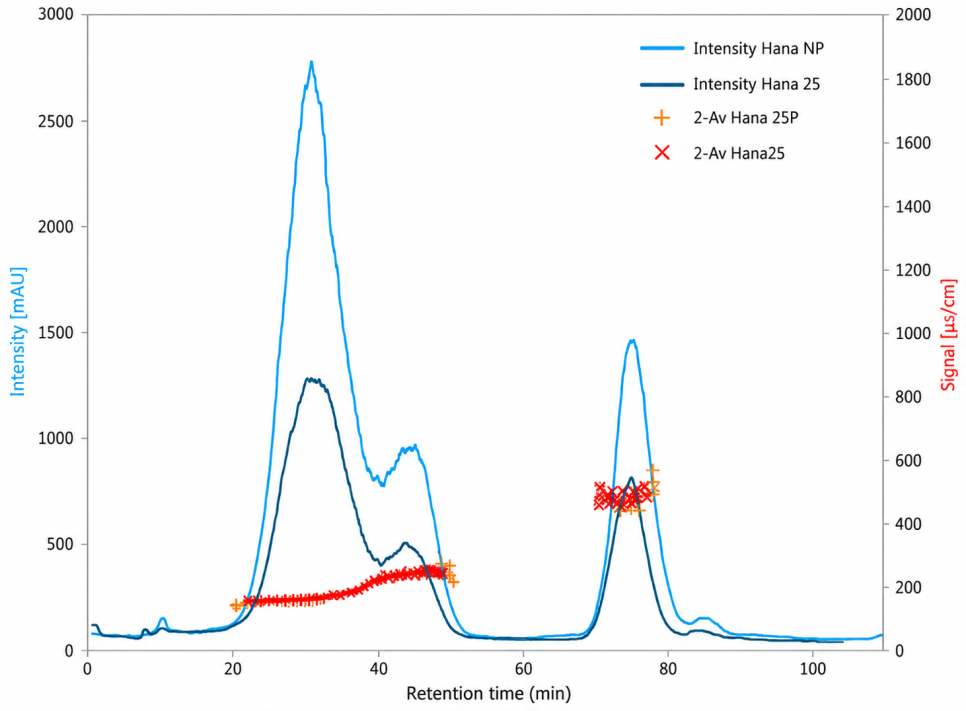
[Fig. DLS-fractogram: Silica NP separation using Centrifugal FFF coupled with DLS
– Malvern Zetasizer Nano S (dark blue) and ZSP (light blue), red dots hydrodynamic radii ]
In the presented application note SiO2 nanoparticles were used to show the separation efficiency of Centrifugal FFF combined with online-DLS for silica nanoparticles. A 3:2:1 mixture of SiO2 NPs (w %) with average size diameters of 160 nm, 200 nm and 500 nm diluted in water (MilliQ, 10-18 M) with 0.05 % NovaChem100 (v/v) was prepared and injected into the FFF system. In the following the method is briefly addressed: An exponential cross flow proved to be ideal for any kind of nanoparticles to be separated on Centrifugal FFF. A standard method without further method development was chosen to show the ease of separation on this novel system (advantage of separation by density and hydrodynamic radius). The initial FOCUS step provides enough time for the different sample species to relax (6 min), whereas the ELUTION step gives the start point of sample elution. 10 min of constant centrifugal force (1000 rpm, resp. 20.4 % of the maximum rotational speed) is sufficient to ensure nanoparticle separation. An exponential field decay over 80 min was applied. An injection volume of 100 L was chosen (arbitrarily), but even smaller sample volumes can be injected. Pure water with addition of 0.05 % NovaChem100 (v/v) was chosen as eluent.
ㅣConclusion
The hyphenated technology of DLS coupled with Centrifugal FFF proved to be ideal for the investigation of particle sizes (hydro-dynamic radius). This was exemplarily shown for the separation of a silica nanoparticle mix in the range of 160 – 500 nm. By choosing the DLS device the sensitivity for detection of these nanoparticles can be further increased. A 2-fold higher sensitivity was obtained by using the Malvern Zetasizer Nano ZSP compared to the Nano S Series. An enhanced optical unit and other technical improvements along with a new laser of higher power (4 mW) renders the Nano ZSP the ideal detector unit for coupling with either Centrifugal FFF (CF2000) or Asymmetrical Flow FFF (AF2000) to obtain hydrodynamic radii information. Whenever a radius of gyration is of interest, a static light scattering device such as the highly sophisticated Multi Angle Light Scattering (MALS) device PN3621 has to be considered.
ㅣReferences
[1] http://www.postnova.com/cf2000-overview.html
[2] http://www.malvern.com/en/products/product-range/zetasizer-range/zetasizer-nano-range/zetasizer-nano-s/default.aspx
[3] http://www.malvern.com/en/products/product-range/zetasizer-range/zetasizer-nano-range/zetasizer-nano-zsp/default.aspx
💬 노바솔루션 문의 |
|
이메일: sales@novasolution.kr |





안녕하세요.
postnova 제품을 국내에 공급하는
해외 공식 한국 총판 노바솔루션입니다.
노바솔루션은 Postnova의 한국 대리점으로서
시료와 분석 목표를 바탕으로 AF2000 AT·MT 모델 선정, AF4/HF5 채널 구성,
MALS·DLS·RI·UV·ICP-MS 연계와 메서드 구축을 지원합니다.
NovaSlution ::
Comparison of Sensitivity: Silica Nanoparticles studied by Zetasizer Nano S vs. ZSP Coupled Online with Centrifugal Field-Flow Fractionation
ㅣIntroduction
Engineered nanoparticles are of widespread use and are nowadays found in various kinds of products in form of additives, thickeners or fillers to obtain products of defi ned properties for food and cosmetic industry and even for biomedical applications. Investigations regarding environmental issues are also addressed wherein low detection limits as well as high sensitivities are required. The characterization of the nanoparticles is therefore highly important to ensure constant quality as well as reliability. The coupling of Centrifugal FFF [1] with online Dynamic Light Scattering (DLS) by the so called “flow-mode” option is a straight forward technology to combine facile separation and real-time detection of nano- and/or microparticles. The “flow-mode” option is realized by connecting a special quartz flow cell into the detector flow stream delivering accurate size information during the analysis. Besides separation and detection this hyphenated setup allows the user to further enhance the sensitivity and to improve the detection limit bearing the advantage to analyze highly diluted samples. This system features the novel CF2000 coupled directly with a DLS detection device (Malvern Zetasizer Nano Series). The sensitivity levels achieved by either using a Zetasizer Nano S [2] or the novel Zetasizer Nano ZSP [3] are compared. Analysis of a silica (SiO2) sample mixture showed a 2-times higher sensitivity by choosing the latter device (Nano ZSP).
ㅣComparative Study: Online Sensitivity of Zetasizer Nano Series S and ZSP Coupled with CF2000
[Fig. DLS-fractogram: Silica NP separation using Centrifugal FFF coupled with DLS
– Malvern Zetasizer Nano S (dark blue) and ZSP (light blue), red dots hydrodynamic radii ]
In the presented application note SiO2 nanoparticles were used to show the separation efficiency of Centrifugal FFF combined with online-DLS for silica nanoparticles. A 3:2:1 mixture of SiO2 NPs (w %) with average size diameters of 160 nm, 200 nm and 500 nm diluted in water (MilliQ, 10-18 M) with 0.05 % NovaChem100 (v/v) was prepared and injected into the FFF system. In the following the method is briefly addressed: An exponential cross flow proved to be ideal for any kind of nanoparticles to be separated on Centrifugal FFF. A standard method without further method development was chosen to show the ease of separation on this novel system (advantage of separation by density and hydrodynamic radius). The initial FOCUS step provides enough time for the different sample species to relax (6 min), whereas the ELUTION step gives the start point of sample elution. 10 min of constant centrifugal force (1000 rpm, resp. 20.4 % of the maximum rotational speed) is sufficient to ensure nanoparticle separation. An exponential field decay over 80 min was applied. An injection volume of 100 L was chosen (arbitrarily), but even smaller sample volumes can be injected. Pure water with addition of 0.05 % NovaChem100 (v/v) was chosen as eluent.
ㅣConclusion
The hyphenated technology of DLS coupled with Centrifugal FFF proved to be ideal for the investigation of particle sizes (hydro-dynamic radius). This was exemplarily shown for the separation of a silica nanoparticle mix in the range of 160 – 500 nm. By choosing the DLS device the sensitivity for detection of these nanoparticles can be further increased. A 2-fold higher sensitivity was obtained by using the Malvern Zetasizer Nano ZSP compared to the Nano S Series. An enhanced optical unit and other technical improvements along with a new laser of higher power (4 mW) renders the Nano ZSP the ideal detector unit for coupling with either Centrifugal FFF (CF2000) or Asymmetrical Flow FFF (AF2000) to obtain hydrodynamic radii information. Whenever a radius of gyration is of interest, a static light scattering device such as the highly sophisticated Multi Angle Light Scattering (MALS) device PN3621 has to be considered.
ㅣReferences
[1] http://www.postnova.com/cf2000-overview.html
[2] http://www.malvern.com/en/products/product-range/zetasizer-range/zetasizer-nano-range/zetasizer-nano-s/default.aspx
[3] http://www.malvern.com/en/products/product-range/zetasizer-range/zetasizer-nano-range/zetasizer-nano-zsp/default.aspx