
안녕하세요.
postnova 제품을 국내에 공급하는
해외 공식 한국 총판 노바솔루션입니다.
노바솔루션은 Postnova의 한국 대리점으로서
시료와 분석 목표를 바탕으로 AF2000 AT·MT 모델 선정, AF4/HF5 채널 구성,
MALS·DLS·RI·UV·ICP-MS 연계와 메서드 구축을 지원합니다.
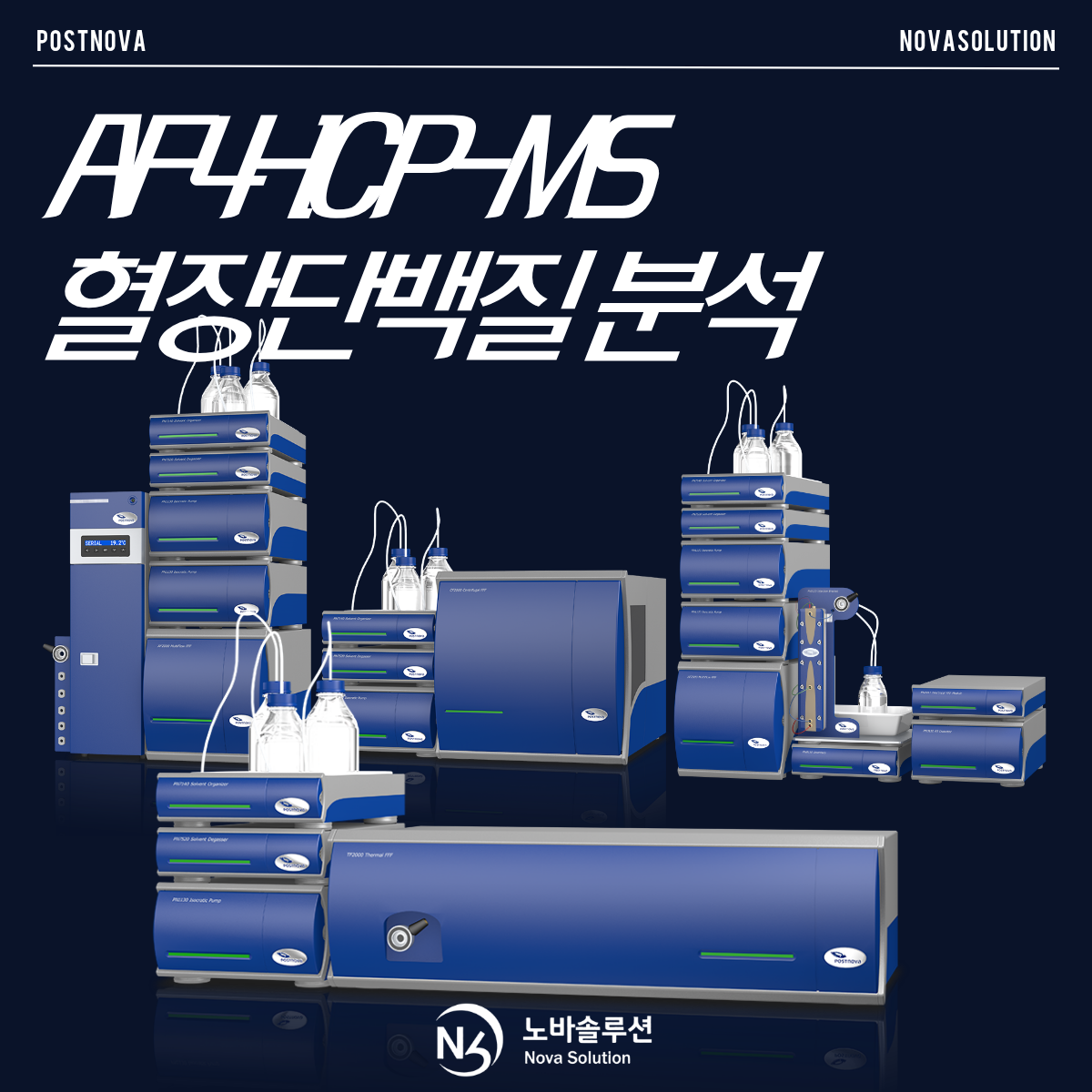
Hyphenation of Asymmetrical Flow Field-Flow Fractionation and ICPMS for Multi-Element Analysis and Characterization of Plasma Proteins |
Julien Heroult, Heidi Goenaga-Infante
LGC Limited, Middlesex, UK
ㅣIntroduction
Human Serum Albumin (HSA) and Transferrin are two main plasma proteins that are known to bind and transfer metal ions in biological fluids. Metal-protein complexes are involved in many health studies such as metal-based drugs for cancer or diabetes treatments. Chromatography techniques hyphenated with ICP-MS and MALDI-TOF-MS have been used to investigate metal speciation and metal binding kinetics. Amongst them, FFF offers significant advantages including a higher sample recovery and the applicability of non-denaturing and less destructive carriers [1].
System Setup
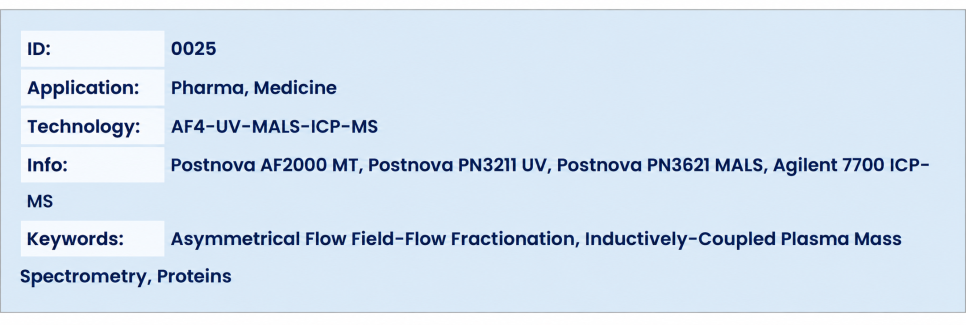
ㅣAF2000 MultiFlow Mid Temperature Flow FFF
ㅣAgilent 7700x ICP-MS
RF power: 1500 W
Sampling depth: 7.2 mm
Carrier gas flow rate: 12 L/min
Dilution gas flow rate: Off
Sampler / Skimmer cones: Ni/Ni
Nebulizer: MicroMist
Spray chamber temperature: 2°C
Helium cell gas flow rate: 9 mL/min
Monitored isotopes and 34S, 57Fe, 63Cu, 65Cu, 66Zn (at 0.5 sec/mass), 56Fe (at 0.1 sec/mass)
ㅣSize Determination/Distribution/Quantification and Inorganic Species Identification
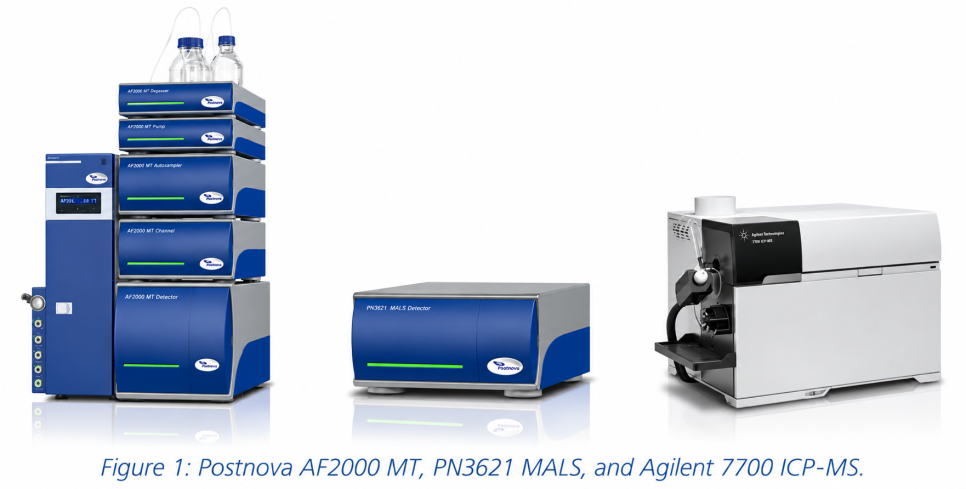
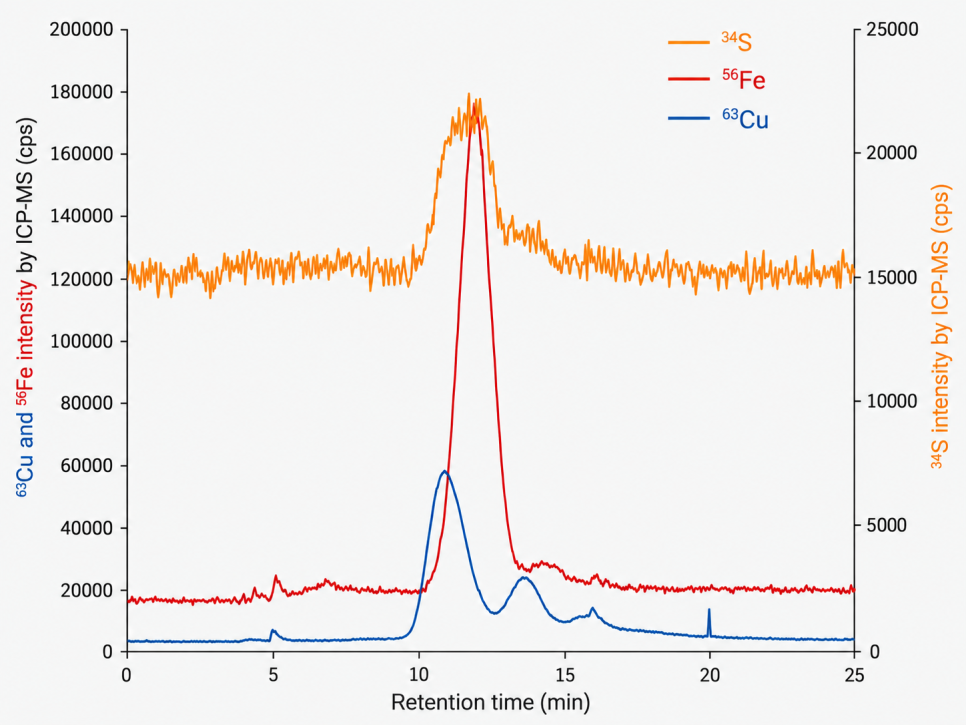
In this study, Asymmetrical Flow FFF (AF4) was used to separate a mixture of Human Serum Albumin – binding 63Cu and Transferrin – binding 56Fe metal ions. The AF4 system separated the proteins by size and detected the metal ions by ICP-MS to obtain metal distributions of the protein mixture. In Fig. 2 the lower blue line refers to the separated HSA protein and the red line to Transferrin. According to the intensity signal of the ICP-MS, both proteins show a clear separation into Monomer (HSA: 10 to 12 min, Transferrin: 11 to 13 min), Dimer (HSA: 12 to 14 min, Transferrin: 14 to 15 min), Trimer (HSA: 15 to 16 min) and higher Aggregates (more than 16 min). The obtained results demonstrate that AF4-ICP-MS is an element selective detection technique for plasma proteins such as Human Serum Albumin (63Cu blue line) and Transferrin (56Fe red line). This is most important for applications in which the two plasma proteins are acting as binders of the same element. Additionally, the simultaneous coupling of FFF with UV-Vis and MALS detection provided approximate molecular mass values of 6.6 x 10⁴ g/mol for HSA and 7.6 x 10⁴ g/mol for transferrin. These values fairly agree with the molecular masses reported for these proteins by the manufacturer.
ㅣField-Flow Fractionation ICP-MS Benefits
Identification of metal uptake in plasma enables individual patient physiology
Investigation and optimization of therapeutic protein and antibody production
Applicable for detection of protein contamination
Quality control of therapeutic protein and antibodies
ㅣConclusion
This work demonstrates that FFF-ICP-MS is a promising tool for the non-denaturing and element-selective detection of proteins such as Human Serum Albumin and Transferrin, which are involved in many health studies. This is particularly attractive for applications in which the two plasma proteins act as binders of the same element (e.g. vanadium in Diabetes studies). The further improvement in selectivity and multi-elemental capability offered by ICP-MS detection guarantees the future application of FFF-ICP-MS to the sulphur/metal speciation of more complex mixtures of metal-containing proteins in biological samples. The simultaneous online combination of this hyphenated technique to UV-Vis/MALS offers a simple and straightforward approach to tentative verifi cation of protein identity, which is particularly useful for routine bio-measurements.
ㅣReferences
[1] Heroult, J., Havard, T., and Goenage Infante, H., The Column, 2012, 8(14), 11-15.
💬 노바솔루션 문의 |
|
이메일: sales@novasolution.kr |





안녕하세요.
postnova 제품을 국내에 공급하는
해외 공식 한국 총판 노바솔루션입니다.
노바솔루션은 Postnova의 한국 대리점으로서
시료와 분석 목표를 바탕으로 AF2000 AT·MT 모델 선정, AF4/HF5 채널 구성,
MALS·DLS·RI·UV·ICP-MS 연계와 메서드 구축을 지원합니다.
NovaSlution ::
Hyphenation of Asymmetrical Flow Field-Flow Fractionation and ICPMS for Multi-Element Analysis and Characterization of Plasma Proteins
Julien Heroult, Heidi Goenaga-Infante
LGC Limited, Middlesex, UK
ㅣIntroduction
Human Serum Albumin (HSA) and Transferrin are two main plasma proteins that are known to bind and transfer metal ions in biological fluids. Metal-protein complexes are involved in many health studies such as metal-based drugs for cancer or diabetes treatments. Chromatography techniques hyphenated with ICP-MS and MALDI-TOF-MS have been used to investigate metal speciation and metal binding kinetics. Amongst them, FFF offers significant advantages including a higher sample recovery and the applicability of non-denaturing and less destructive carriers [1].
System Setup
ㅣAF2000 MultiFlow Mid Temperature Flow FFF
PN3211 UV/Vis-Detector
PN3621 21-Angle MALS-Detector
Spacer: 350 µm
Eluent: 100 mM Ammonium Acetate, pH 7
ㅣAgilent 7700x ICP-MS
RF power: 1500 W
Sampling depth: 7.2 mm
Carrier gas flow rate: 12 L/min
Dilution gas flow rate: Off
Sampler / Skimmer cones: Ni/Ni
Nebulizer: MicroMist
Spray chamber temperature: 2°C
Helium cell gas flow rate: 9 mL/min
Monitored isotopes and 34S, 57Fe, 63Cu, 65Cu, 66Zn (at 0.5 sec/mass), 56Fe (at 0.1 sec/mass)
ㅣSize Determination/Distribution/Quantification and Inorganic Species Identification

In this study, Asymmetrical Flow FFF (AF4) was used to separate a mixture of Human Serum Albumin – binding 63Cu and Transferrin – binding 56Fe metal ions. The AF4 system separated the proteins by size and detected the metal ions by ICP-MS to obtain metal distributions of the protein mixture. In Fig. 2 the lower blue line refers to the separated HSA protein and the red line to Transferrin. According to the intensity signal of the ICP-MS, both proteins show a clear separation into Monomer (HSA: 10 to 12 min, Transferrin: 11 to 13 min), Dimer (HSA: 12 to 14 min, Transferrin: 14 to 15 min), Trimer (HSA: 15 to 16 min) and higher Aggregates (more than 16 min). The obtained results demonstrate that AF4-ICP-MS is an element selective detection technique for plasma proteins such as Human Serum Albumin (63Cu blue line) and Transferrin (56Fe red line). This is most important for applications in which the two plasma proteins are acting as binders of the same element. Additionally, the simultaneous coupling of FFF with UV-Vis and MALS detection provided approximate molecular mass values of 6.6 x 10⁴ g/mol for HSA and 7.6 x 10⁴ g/mol for transferrin. These values fairly agree with the molecular masses reported for these proteins by the manufacturer.
ㅣField-Flow Fractionation ICP-MS Benefits
Identification of metal uptake in plasma enables individual patient physiology
Investigation and optimization of therapeutic protein and antibody production
Applicable for detection of protein contamination
Quality control of therapeutic protein and antibodies
ㅣConclusion
This work demonstrates that FFF-ICP-MS is a promising tool for the non-denaturing and element-selective detection of proteins such as Human Serum Albumin and Transferrin, which are involved in many health studies. This is particularly attractive for applications in which the two plasma proteins act as binders of the same element (e.g. vanadium in Diabetes studies). The further improvement in selectivity and multi-elemental capability offered by ICP-MS detection guarantees the future application of FFF-ICP-MS to the sulphur/metal speciation of more complex mixtures of metal-containing proteins in biological samples. The simultaneous online combination of this hyphenated technique to UV-Vis/MALS offers a simple and straightforward approach to tentative verifi cation of protein identity, which is particularly useful for routine bio-measurements.
ㅣReferences
[1] Heroult, J., Havard, T., and Goenage Infante, H., The Column, 2012, 8(14), 11-15.