
안녕하세요.
postnova 제품을 국내에 공급하는
해외 공식 한국 총판 노바솔루션입니다.
노바솔루션은 Postnova의 한국 대리점으로서
시료와 분석 목표를 바탕으로 AF2000 AT·MT 모델 선정, AF4/HF5 채널 구성,
MALS·DLS·RI·UV·ICP-MS 연계와 메서드 구축을 지원합니다.
Quantification of Adeno-Associated Virus Aggregation Using Asymmetrical Flow Field-Flow Fractionation |
ㅣIntroduction
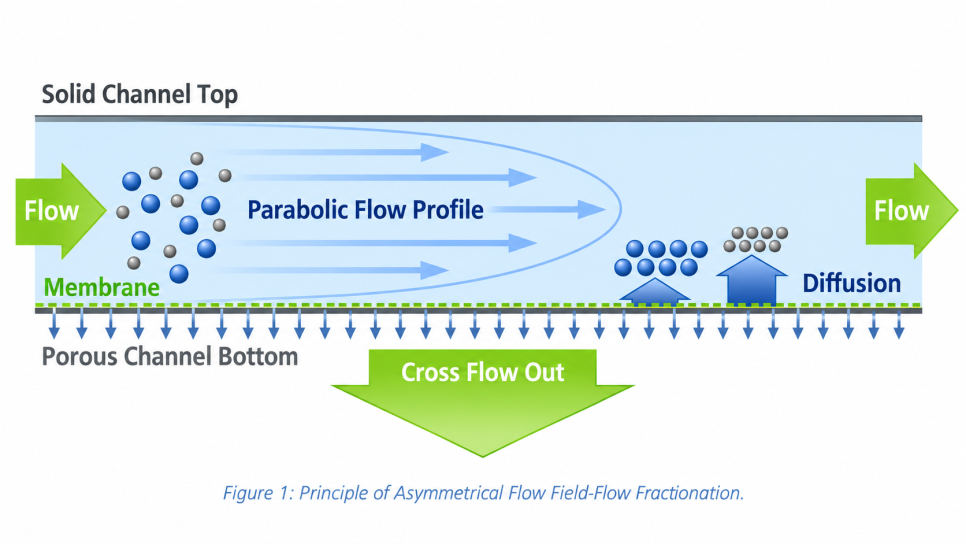
Adeno-associated viruses (AAVs) are increasingly used for gene therapy due to their versatility and safety. They can be loaded with DNA or RNA and delivered to a specific cell type, with the goal being to treat or cure disease [1]. One of the biggest concerns for manufacturing a uniform AAV suspension is the presence of viral aggregates, which can create problems with transduction efficiency, biodistribution, and immunogenicity [2]. Due to their large size, often over 100 nm in diameter, AAV aggregates are challenging to separate and characterize by column-based chromatography techniques such as size exclusion chromatography. In this application note, we present data on separation of AAVs and their aggregates using Asymmetrical Flow Field-Flow Fractionation (AF4) and measurement of their radius of gyration (Rg or Root Mean Square radius, R.M.S.) by Multi Angle Light Scattering (MALS). A schematic for the AF4 channel is shown in Figure 1. The combination of cross flow and channel flow causes size separation over the course of the analysis, with smaller particles eluting before larger particles, including aggregates. As the particles are eluted from the channel they flow sequentially through the connected detectors.
ㅣExperimental Details and Results
An AAV sample was divided into two aliquots; one aliquot was stressed to induce aggregation, creating two samples with different degrees of aggregation, called here “non-stressed” and “stressed”. To separate by size and characterize the AAVs and their aggregates, an AF4 system (Postnova AF2000) was used with two detectors monitoring the eluting sample. Firstly, a Postnova 21-angle Multi Angle Light Scattering detector (MALS, PN3621) for measuring the Rg of AAVs and their aggregates; and secondly a UV/Vis detector (PN3211) which is sensitive to virus concentration and can be used to calculate the relative amount of aggregate present compared to AAV monomer. A carrier solution of 1x phosphate buffered saline was used in the experiments.
The UV response for the two AAV samples is shown in Figure 3. The AAV monomer elutes first, around 5 - 10 minutes for both samples. The aggregate elutes later, around 30 - 35 minutes. The relative amount of aggregate is calculated by integrating the area under the UV-peaks. For the non-stressed sample, the aggregate was present at 6.1 %, and for the stressed sample the aggregate was present at 23.7 %.
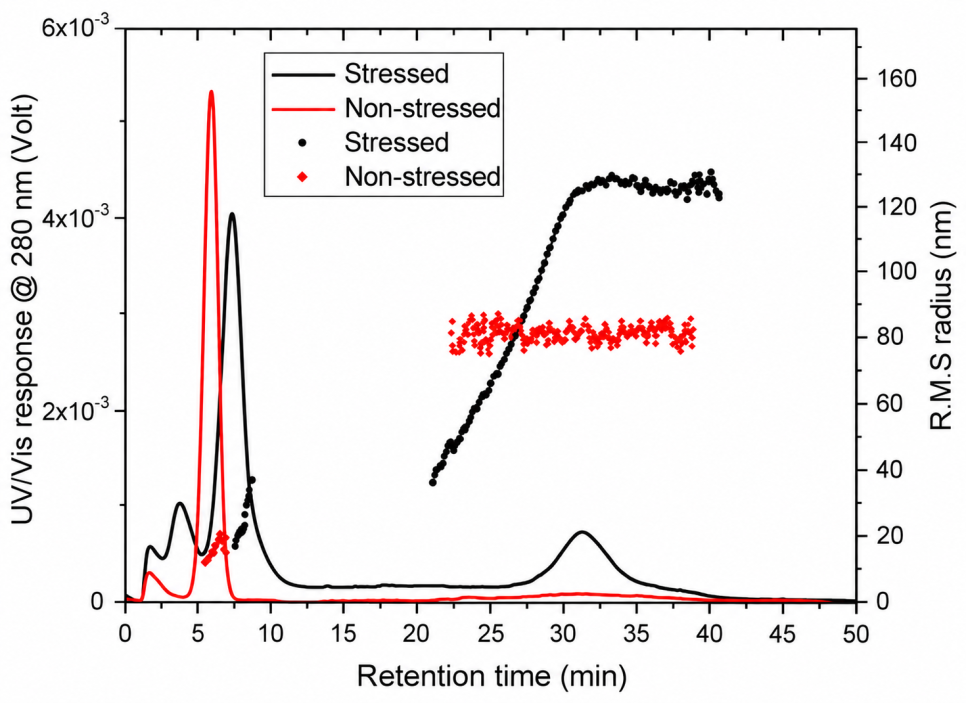
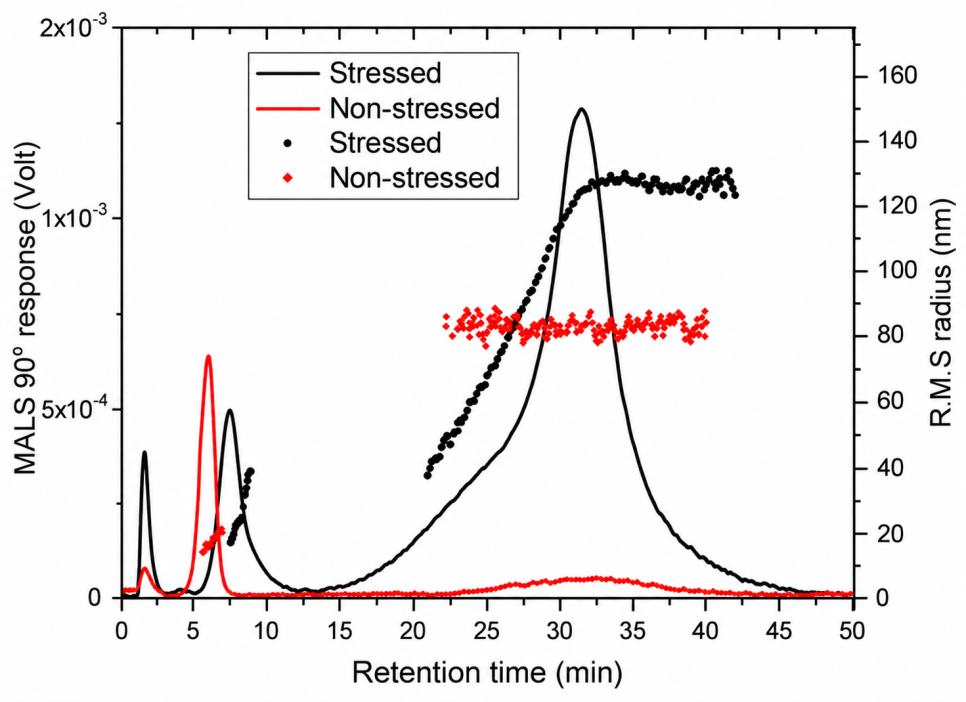
In Figure 4, the MALS response is plotted as the black and red traces, with Rg calculated at each time point and plotted as black and red dots. The monomers have measured sizes consistent with most AAVs, around 15 - 30 nm in radius. The aggregates in the non-stressed AAV sample are monodisperse, with an Rg around 80 nm. For the stressed AAV, there is substantial polydispersity in the aggregate size, ranging from about 40 nm to 120 nm in radius.
ㅣConclusion
From the data presented here, we see that AF4-MALS-UV can separate and size large AAV aggregates, and discern a difference in aggregate concentration due to the stressing protocol. Most size exclusion chromatography columns would fi lter out some or all aggregates this large, resulting in incorrect determination of the aggregate content or even the false conclusion that no aggregates are present.
ㅣReferences
[1] M.F. Naso, B. Tomkowicz, W.L. Perry III, W.R. Strohl, BioDrugs, 2017; 31(4), 317–334.
[2] J.F. Wright, T. Le, J. Prado, J. Bahr-Davidson, P.H. Smith, Z. Zhen, J.M. Sommer, G.F. Pierce, G. Qu, Molecular Therapy, 2005, 12(1), 171-178.
💬 노바솔루션 문의 |
|
이메일: sales@novasolution.kr |





안녕하세요.
postnova 제품을 국내에 공급하는
해외 공식 한국 총판 노바솔루션입니다.
노바솔루션은 Postnova의 한국 대리점으로서
시료와 분석 목표를 바탕으로 AF2000 AT·MT 모델 선정, AF4/HF5 채널 구성,
MALS·DLS·RI·UV·ICP-MS 연계와 메서드 구축을 지원합니다.
NovaSlution ::
Quantification of Adeno-Associated Virus Aggregation Using Asymmetrical Flow Field-Flow Fractionation
ㅣIntroduction
Adeno-associated viruses (AAVs) are increasingly used for gene therapy due to their versatility and safety. They can be loaded with DNA or RNA and delivered to a specific cell type, with the goal being to treat or cure disease [1]. One of the biggest concerns for manufacturing a uniform AAV suspension is the presence of viral aggregates, which can create problems with transduction efficiency, biodistribution, and immunogenicity [2]. Due to their large size, often over 100 nm in diameter, AAV aggregates are challenging to separate and characterize by column-based chromatography techniques such as size exclusion chromatography. In this application note, we present data on separation of AAVs and their aggregates using Asymmetrical Flow Field-Flow Fractionation (AF4) and measurement of their radius of gyration (Rg or Root Mean Square radius, R.M.S.) by Multi Angle Light Scattering (MALS). A schematic for the AF4 channel is shown in Figure 1. The combination of cross flow and channel flow causes size separation over the course of the analysis, with smaller particles eluting before larger particles, including aggregates. As the particles are eluted from the channel they flow sequentially through the connected detectors.
ㅣExperimental Details and Results
An AAV sample was divided into two aliquots; one aliquot was stressed to induce aggregation, creating two samples with different degrees of aggregation, called here “non-stressed” and “stressed”. To separate by size and characterize the AAVs and their aggregates, an AF4 system (Postnova AF2000) was used with two detectors monitoring the eluting sample. Firstly, a Postnova 21-angle Multi Angle Light Scattering detector (MALS, PN3621) for measuring the Rg of AAVs and their aggregates; and secondly a UV/Vis detector (PN3211) which is sensitive to virus concentration and can be used to calculate the relative amount of aggregate present compared to AAV monomer. A carrier solution of 1x phosphate buffered saline was used in the experiments.
The UV response for the two AAV samples is shown in Figure 3. The AAV monomer elutes first, around 5 - 10 minutes for both samples. The aggregate elutes later, around 30 - 35 minutes. The relative amount of aggregate is calculated by integrating the area under the UV-peaks. For the non-stressed sample, the aggregate was present at 6.1 %, and for the stressed sample the aggregate was present at 23.7 %.
In Figure 4, the MALS response is plotted as the black and red traces, with Rg calculated at each time point and plotted as black and red dots. The monomers have measured sizes consistent with most AAVs, around 15 - 30 nm in radius. The aggregates in the non-stressed AAV sample are monodisperse, with an Rg around 80 nm. For the stressed AAV, there is substantial polydispersity in the aggregate size, ranging from about 40 nm to 120 nm in radius.
ㅣConclusion
From the data presented here, we see that AF4-MALS-UV can separate and size large AAV aggregates, and discern a difference in aggregate concentration due to the stressing protocol. Most size exclusion chromatography columns would fi lter out some or all aggregates this large, resulting in incorrect determination of the aggregate content or even the false conclusion that no aggregates are present.
ㅣReferences
[1] M.F. Naso, B. Tomkowicz, W.L. Perry III, W.R. Strohl, BioDrugs, 2017; 31(4), 317–334.
[2] J.F. Wright, T. Le, J. Prado, J. Bahr-Davidson, P.H. Smith, Z. Zhen, J.M. Sommer, G.F. Pierce, G. Qu, Molecular Therapy, 2005, 12(1), 171-178.